2026-03-10

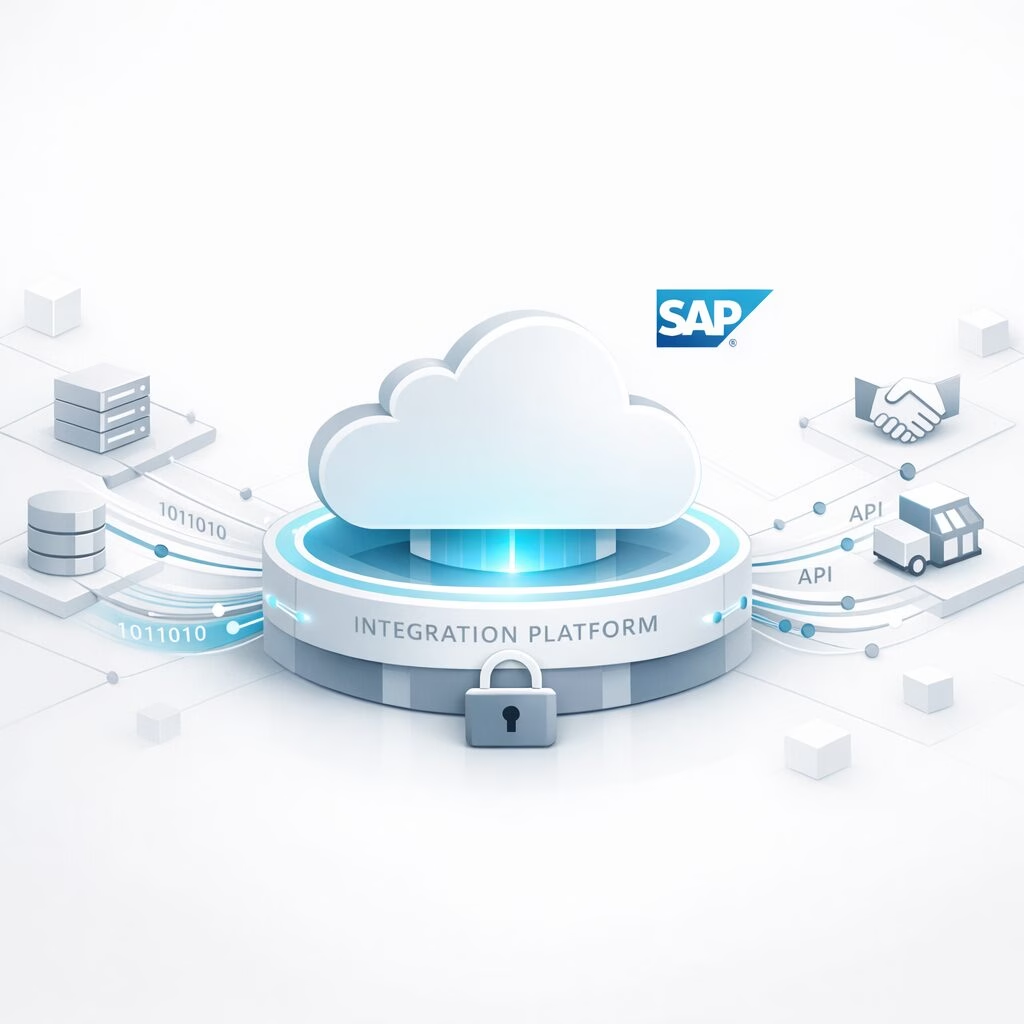
Secure partner connection to the SAP Integration Suite

Structured and secure integration of internal and external partners

In modern integration landscapes, companies must connect not only internal systems, but also a large number of external partners efficiently and securely. Especially with integration platforms such as the SAP Integration Suite, new requirements arise in terms of security, controllability and scalability.

Internal and external partners must be integrated into integration processes in a partner-specific, secure and traceable manner. Without a clearly defined concept for partner data management, the connection can quickly become complex and time-consuming.

As part of the InnovateSAP initiative, we support companies in developing suitable best-practice concepts for secure and efficient partner integration.

Starting situation

Many companies currently do not have a central, partner-specific concept for connecting internal and external partners to their integration platform.

This creates several challenges during operation:

  • High effort in connecting new partners
  • Complex care and maintenance of existing connections
  • Lack of central controllability of access
  • Potential security risks

A structured concept for partner connection via SOAP, HTTP or OData interfaces is therefore becoming a central success factor for a stable and secure integration architecture.

Approach

Several architectural concepts are available for the secure and efficient connection of internal and external partners. These differ in terms of security level, scalability and administration effort.

Depending on the requirements and number of partners, three established concepts can be used:

Concept I – Role-based BTP Service Keys

Partners are connected via service instances and service keys within the SAP Business Technology Platform. Access is role-based and can be accessed via various authentication mechanisms:

  • Basic Authentication
  • OAuth
  • Certificates

Integration via an identity provider is also possible, for example via SAP Cloud Identity Services or external identity providers such as Microsoft Azure Active Directory.

For an increased level of security, it is recommended to use OAuth or certificate authentication .

Concept II – Certificate-based partner connection

In this approach, authentication is carried out via client certificates, which achieves a particularly high level of security.

Typical features:

  • Partner-specific integration flows
  • Clear separation of partner access
  • High traceability and auditability

This concept is particularly suitable for companies with regulatory requirements or particularly sensitive data.

Concept III – SAP API Management

SAP API Management can be used to build a flexible and scalable partner ecosystem.

Various security mechanisms are available:

  • OAuth
  • API Keys
  • IP Filters
  • Quotas and Spike Arrest
  • Threat Protection

By combining OAuth and API Keys , fine-grained access control can be implemented.

All concepts also support secure connection to on-premise systems via the SAP Cloud Connector. This enables a secure tunnel between the on-premise landscape and the cloud integration platform.

Steps of implementation

The structured use of these concepts enables companies to systematically develop their partner integration and adapt it to your individual requirements.

Providing clarity

In the first step, the existing partner landscape is analyzed. The following are examined:

  • How many internal and external partners are connected
  • What are the safety requirements
  • which interfaces are used
  • which regulatory requirements must be taken into account

This analysis creates transparency about the requirements and forms the basis for the selection of a suitable integration concept.

Enabling innovation

Based on the analysis, the appropriate architectural concept is defined. Depending on the requirements, different models can be used.

Concept I – Simple and efficient

  • Fast implementation
  • Low integration effort
  • Cost-efficient with a small number of partners
  • Easy administration

Ideal for: few partners with moderate security requirements

Concept II – Maximum safety

  • Highest level of security through certificates
  • High auditability
  • Clear partner separation
  • suitable for regulated industries

Ideal for: a few partners with high security requirements

Concept III – Flexible and scalable

  • Flexible authentication
  • High scalability
  • fine-grained access control
  • Protection against overload through quotas and spike arrest

Ideal for: larger partner ecosystems with different requirements

Accelerate proof of concept

In the next step, a proof of concept (PoC) is implemented, in which the selected concept is tested in a realistic integration scenario.

The following are examined:

  • how to connect new partners
  • How authentication and access control work
  • how maintenance and administration can be implemented

The PoC makes it possible to validate the chosen architecture under realistic conditions before it is rolled out company-wide.

Results and Benefits

The result is a structured and secure partner integration concept that is being implemented as part of the InnovateSAP initiative.

This provides companies with a clear strategy for connecting internal and external partners to the SAP Integration Suite.

The added value is evident on several levels.

Operational

  • Less effort for partner connections
  • Simplified administration and maintenance
  • Clear access controls and responsibilities

Professional

  • stable and secure integration processes
  • Transparent partner communication
  • Better traceability of data flows

Management

  • Clear governance for partner integrations
  • Better controllability of the integration architecture
  • Reduced safety and operational risks

Within the framework of InnovateSAP , this approach supports companies in developing their integration landscape in a structured way and in building a secure, controllable partner integration that is adapted to the respective requirements .

2024-02-09

SAP Identity Service: An Overview and Application Scenarios

SAP Identity Service: An Overview and Application Scenarios

Welcome to HO2 and our InnovateSAP initiative, which aims to bring clarity and understanding to complex topics such as BTP’s SAP Identity Service. In this introduction, we’ll take a deep dive into SAP Identity Service, which plays a central role in managing user identities and permissions, both in the cloud and on-premise environments. Our expertise and innovative approaches, especially through the InnovateSAP initiative, enable us to offer effective solutions that meet the needs of modern businesses.

What is SAP Identity Service?

The SAP Identity Service consists of two main components: Identity Authentication and Identity Provisioning. These services provide basic user authentication and provisioning capabilities that are essential for all Intelligent Enterprise integration and/or extension scenarios.

Identity Authentication

Identity Authentication is a cloud service for authentication, single sign-on (SSO) and user management in SAP cloud and on-premise applications. It can act as an identity provider as well as a proxy to integrate with an existing single sign-on infrastructure.

BTP User EditBTP UsersIdentity Provisioning

Identity provisioning provides a comprehensive and cost-effective approach to identity lifecycle management in the cloud. It helps to provide identities and their permissions for various cloud and on-premise business applications.Role Collections - SAP BTP Cockpit

Application Scenarios and Benefits

The flexibility and depth of integration of the SAP Identity Service enable a variety of application scenarios, ranging from business-to-employee (B2E) to business-to-business (B2B) to business-to-consumer (B2C). Here are some examples:

  • Secure user management and access control: The Cloud Identity Service makes it possible to integrate existing user managements, eliminating the need for separate maintenance of internal application users in the cloud.
  • Standards and certifications: Customers can comply with high security guidelines with the standards and certifications offered.
  • Integration with other IAM solutions: Other IAM solutions can be integrated by using standards for authentication (OAuth) and replication of users (SCIM).
  • External user management: External users can be managed separately in the cloud, allowing access to digital workspaces.
  • Additional layer of security: For external access, BTP provides an additional layer of security over direct access to the corporate network.

InnovateSAP: Our contribution

Through our InnovateSAP initiative, we not only provide education about such key technologies, but also develop customized solutions that are specifically tailored to the needs of our customers. We help organizations optimize their security architecture, improve user experience, and minimize administrative overhead.

Result

SAP Identity Service plays a critical role in the modern IT landscape by enabling secure, scalable, and efficient management of user identities and authorizations. By leveraging its extensive features and integration options, organizations can raise their security standards while ensuring a seamless user experience across different applications and platforms. With HO2 and our InnovateSAP initiative by your side, you can be sure that you will receive the best possible solutions to achieve your digital transformation goals.

← Zur Startseite